-
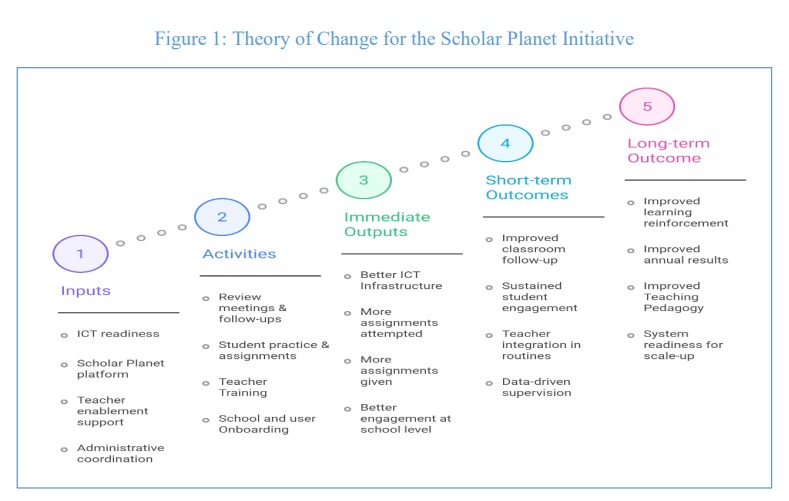
The Scholar Planet Digital Learning Initiative, implemented by the Government of Uttar Pradesh under Samagra Shiksha (Secondary) in partnership with GCAP World Softech Pvt. Ltd., is designed to strengthen classroom instruction, improve student engagement, and enable data-driven academic monitoring across government secondary schools through curriculum-aligned digital learning tools.
-
Following a pilot phase in 2024, the initiative was scaled for statewide rollout in February 2025.
-
This impact assessment evaluates early-stage adoption and engagement outcomes of the initiative in 24 Model Government Secondary Schools in Sitapur district between July and November 2025, where implementation was supported through additional CSR inputs.
-
Drawing on administrative platform analytics, infrastructure records, monitoring dashboards, and qualitative field observations, the assessment examines how teacher engagement, digital access, institutional coordination, and implementation design have influenced routine teaching–learning processes.
-
The initiative recorded substantial improvement in teacher adoption and classroom integration during the assessment period.
-
Active teacher participation increased from approximately 66 percent in July to over 90 percent by November 2025, exceeding committed implementation targets.
-
Teachers increasingly integrated platform-based assignments, assessments, videos, and dashboards into weekly classroom delivery through structured academic plans and subject-wise tasks.
-
Automated evaluation tools and real-time monitoring dashboards reduced administrative burden, while chapter-aligned digital content supported greater lesson standardization in line with UP State Board and NCERT frameworks.
-
Student participation and usage also improved significantly.
Active student engagement among logged-in users increased from approximately 66 percent to over 90 percent, while active implementation coverage relative to targets rose from 25 percent to over 71 percent within five months. -
During this period, students attempted over 86,000 assignments and completed more than 1.25 lakh learning sessions across Grades 9–12.
-
Structured ICT lab scheduling enabled students without personal smartphones to access digital content through in-school sessions, while homework-based assignments and AI-supported practice extended learning beyond school hours.
-
Improvements in ICT readiness further strengthened access and inclusion.
-
Comparative reviews conducted between July and October indicate that several participating schools previously reporting zero functional computers were equipped with four to eight operational systems alongside improved internet connectivity and power backup.
-
These infrastructure upgrades reduce reliance on personal devices and enable shared digital access within school premises, particularly benefiting students from resource-constrained households and supporting equitable participation, including among girls, who constitute 72 percent of onboarded users statewide.
-
Implementation outcomes were reinforced by a collaborative governance framework linking state level policy direction, district-level coordination, school leadership, and field-level technical support.
-
Real-time dashboards enabled continuous performance tracking and district-level review, facilitating targeted administrative intervention where required.
-
Over time, teacher adoption transitioned from cautious onboarding to active instructional usage, accompanied by increasing parental acceptance of structured digital engagement for academic purposes.
-
The initiative adopts a blended implementation model combining ICT lab sessions, classroom integration through structured weekly academic plans, and homework-based reinforcement.
-
Continuous platform upgrades based on field feedback and the introduction of emerging courses such as Blockchain, Internet of Things (IoT), and Robotics recorded participation levels higher than the platform average, indicating strong student demand for future-oriented and skill-based learning.
-
Findings should be interpreted as indicative of implementation effectiveness rather than causal academic impact, as the assessment relies on descriptive engagement indicators derived from administrative platform data and does not include standardized learning outcome measures.
-
Overall, early implementation experience from Sitapur district suggests that sustained teacher enablement, improved ICT readiness, and structured administrative coordination can accelerate digital adoption and stabilize platform usage within public school systems.
-
The collaborative public–private implementation model offers operational insights for scaling curriculum-aligned digital learning interventions in resource-constrained government education settings while supporting equity in access and institutional accountability.