

The Role of AI in Modern Education: How Technology is Changing the Way We Learn
May 22, 2026
महात्मा बुद्ध का जीवन और उनके महान विचार
June 4, 2026
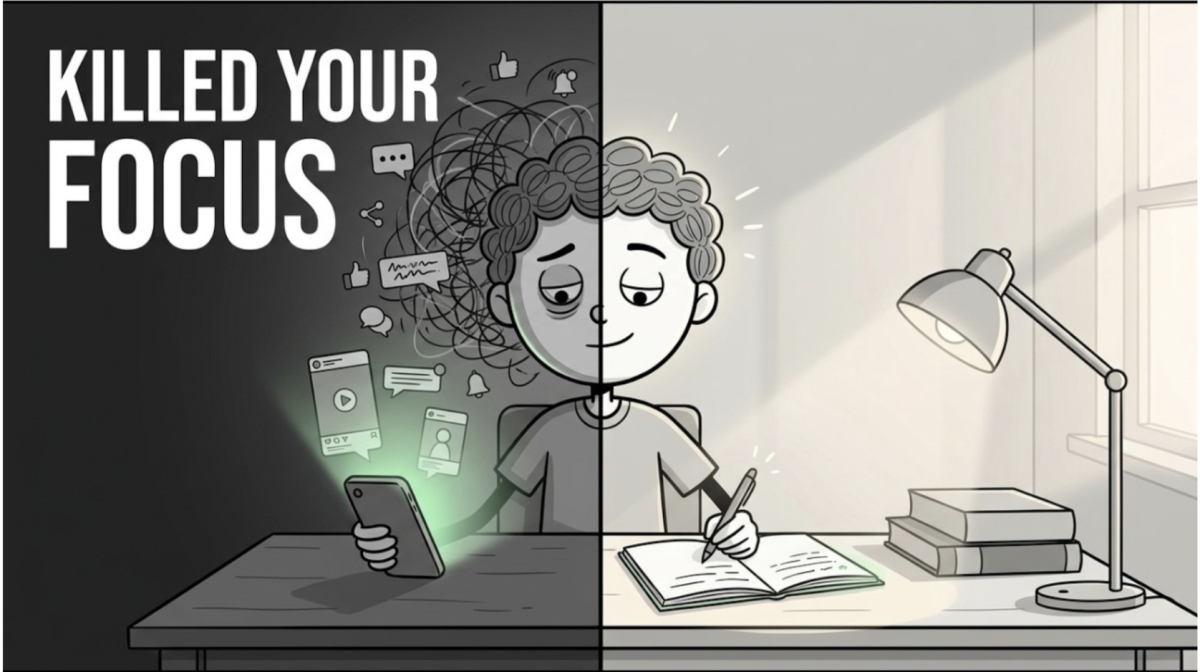
Picture this: You sit down to study for an exam. You open your notebook. Two minutes later, you pick up your phone — just to check one notification. Forty minutes later, you’re watching a video about a cat that plays the piano, and you have no idea how you got there.
Sound familiar? You’re not alone and you’re not lazy. Your brain has been hijacked.
Did You Know? A University of California study found that after a digital distraction, it takes an average of 23 minutes and 15 seconds to fully return to your original task. That means every single social media check is costing you almost half an hour of real focus.
Table of Contents
- What Is Actually Happening to Your Brain
- The Science: Dopamine, Distraction & the Focus Trap
- Warning Signs You’ve Already Lost Your Focus
- How Social Media Is Hurting Students Specifically
- How to Unplug: 8 Proven Strategies
- The 7-Day Digital Detox Challenge
- Key Takeaways & Conclusion
1. What Is Actually Happening to Your Brain
Social media apps are not just platforms for sharing photos and memes. They are precision-engineered attention machines built by some of the world’s most brilliant engineers and psychologists to keep you scrolling for as long as possible.
Every swipe, like, comment, and notification is carefully designed to trigger a chemical response in your brain. Understanding this is the first step to breaking free.
Here’s what happens the moment you open Instagram, YouTube Shorts, or any social app:
- Your brain releases a small hit of dopamine the “feel-good” chemical
- You feel a brief burst of pleasure and want more
- You swipe again. Another hit. And again.
- Over time, your brain starts expecting this constant stimulation
- Anything that doesn’t provide it like studying or reading feels boring and unbearable
The most insidious feature of all? Variable reward. Sometimes you get 50 likes. Sometimes 2. Sometimes a mean comment. You never know what you’ll get just like a slot machine. And that unpredictability keeps you hooked far more powerfully than a consistent reward ever could.
2. The Science: Dopamine, Distraction & the Focus Trap
Your brain has a prefrontal cortex the region responsible for focus, decision-making, and self-control. Chronic social media use literally shrinks this region and rewires your neural pathways to crave constant stimulation.
Here are some numbers that should make you pause:
- The average human attention span today is 8 seconds down from 12 seconds in the year 2000
- The average person checks their phone 150 times a day
- Students lose an average of 3.5 productive hours per day to digital distractions
- Research suggests heavy social media users show a 30% reduction in gray matter in the prefrontal cortex
“We are creating a world in which the most engaging thing to do with your attention is the easiest thing to do with it.” Cal Newport, Author of Deep Work
When your brain is in a constant state of low-grade distraction, it becomes physically incapable of the kind of sustained, deep thinking that learning requires. Reading a textbook, solving a math problem, writing an essay these all demand focus that social media is quietly training you to lose.
3. Warning Signs You’ve Already Lost Your Focus
How do you know if social media is already affecting your ability to concentrate? Here are the most common signs:
You feel anxious without your phone. If being separated from your phone for even 30 minutes makes you feel restless or irritable, that’s a classic sign of digital dependency. This anxiety is real, it’s triggered by drops in dopamine that your brain now expects from frequent phone use.
You can’t read for more than 5 minutes without checking your phone. Deep reading requires sustained focus, something social media actively trains you away from. If your eyes drift after a paragraph and you instinctively reach for your phone, your attention span has been significantly shortened.
You scroll in bed and feel tired but can’t sleep. Blue light from screens suppresses melatonin the hormone that signals your brain it’s time to sleep. Scrolling in bed is one of the most damaging habits for student performance. Poor sleep directly impairs memory consolidation and learning.
You feel bad about yourself after using social media. Social media shows you a curated highlight reel of everyone’s life. Constant comparison to filtered, perfect content has been linked to increased rates of depression, anxiety, and low self-esteem especially in students aged 13–22.
You start tasks but never finish them. Social media trains your brain to jump between short bursts of content. This context-switching habit bleeds into your work, making it extremely hard to stay focused on any single task to completion.
The Notification Trap: The average student receives 63 push notifications per day. Each one breaks focus, creates a micro-stress response, and resets your attention clock. Simply having your phone on your desk even face-down and silent reduces your available cognitive capacity by up to 26%.
4. How Social Media Is Hurting Students Specifically
For students, the stakes are uniquely high. Your school years are when your brain is most plastic most capable of deep learning, skill-building, and forming lifelong habits. Social media is competing directly for that developmental window.
| Area of Impact | What Social Media Does | The Result for Students |
| Academic Performance | Replaces study time, breaks concentration | Lower grades, unfinished assignments |
| Sleep Quality | Blue light, late-night scrolling | Poor memory retention, fatigue in class |
| Deep Thinking | Trains shallow, fast-switching attention | Struggle with complex problems and essays |
| Mental Health | Comparison, cyberbullying, FOMO | Anxiety, low self-esteem, depression |
| Real Relationships | Replaces in-person interaction | Loneliness, poor social skills |
| Goal Setting | Instant gratification mindset | Low patience, gives up on long-term goals |
A study published in the Journal of Youth and Adolescence found that students who spent more than 3 hours per day on social media were significantly more likely to report poor mental health, reduced academic motivation, and difficulty concentrating in class.
This isn’t about shaming anyone for using technology. It’s about understanding that the apps in your pocket were designed by billion-dollar companies with one goal: to take as much of your time and attention as possible.
5. How to Unplug: 8 Proven Strategies
Here’s the truth: you don’t need to delete every app. You need to change your relationship with technology from reactive to intentional. Here’s how.
Strategy 1: Start With a Phone-Free Morning
For the first 30–60 minutes after waking up, keep your phone in another room. Use this time to stretch, drink water, journal, or simply let your brain wake up naturally. This single habit has been shown to dramatically improve focus and mood for the entire day.
Your first thoughts of the day set the tone for everything that follows. Don’t let an algorithm decide what those thoughts are.
Strategy 2: Use the Pomodoro Technique
Study for 25 focused minutes, then take a 5-minute break. During focus blocks, your phone goes face-down in another room not just on silent. The Pomodoro Technique works because it makes the task feel manageable, and the built-in breaks remove the anxiety of “I can’t check my phone.”
Platforms like Scholar Planet, with structured assignments and progress tracking, are a perfect companion for this method.
Strategy 3: Turn Off All Non-Essential Notifications
Go to your phone settings right now. Keep only calls and truly essential messages. Every other app Instagram, YouTube, WhatsApp groups should be checked on your schedule, not theirs. You are not an emergency service. Reclaim the right to your own attention.
Strategy 4: Create a “Phone Box” at Your Study Desk
Put a small box or drawer beside your study table. When you sit down to study, your phone goes in the box. Out of sight truly means out of mind, research proves that even the presence of a phone on your desk reduces your cognitive capacity, even if you never touch it.
Strategy 5: Schedule Social Media Like an Appointment
Instead of scrolling whenever a craving strikes, dedicate two 20-minute windows each day for example, after lunch and after dinner to check social media. Having a defined time removes the constant “just one peek” impulse that derails study sessions.
Strategy 6: Replace Scrolling With a Micro-Habit
Every time you feel the urge to check your phone, do 5 deep breaths, take a 2-minute walk, or jot down one thing you’re grateful for. You’re not fighting the urge you’re redirecting it to something that serves you. Over time, this genuinely rewires your brain’s default behavior.
Strategy 7: Create a No-Screen Bedtime Ritual
Set a hard cutoff – no screens 45 minutes before bed. Replace it with reading a physical book, light stretching, or writing in a journal. Your sleep quality will improve within 3–4 days, and better sleep means sharper focus, stronger memory, and better learning outcomes the next day.
Strategy 8: Replace Passive Consumption With Active Learning
When you have the urge to scroll, open Scholar Planet instead. Take a quick quiz, watch a learning video, or explore a new topic with Scholar Buddy. You still get the engagement and dopamine reward of completing something but it builds your knowledge and your future, not just an algorithm’s revenue.
🌟 Scholar Planet Tip: Not all screen time is equal. Using an educational platform with structured assignments, personalized quizzes, and an AI learning assistant gives your brain the engagement it craves while actually building the skills that matter. Replace mindless scrolling with mindful learning at gcapworld.com.
6. The 7-Day Digital Detox Challenge
You don’t need to transform overnight. Start with one small change per day for a week and feel the difference for yourself.
| Day | Challenge |
| Day 1 | No phone for the first 30 minutes after waking up |
| Day 2 | Turn off all non-essential app notifications |
| Day 3 | Study for 25 minutes with your phone in another room |
| Day 4 | No social media before 12 PM |
| Day 5 | No screens for 45 minutes before bedtime |
| Day 6 | Delete one app you spend the most time on mindlessly |
| Day 7 | Share what you learned this week with a friend or family member |
By Day 7, most students report feeling less anxious, more productive, sleeping better, and surprising themselves with how much they can accomplish when distraction is removed. Give yourself this gift.
7. Key Takeaways & Conclusion
✔ Social media apps are engineered to hijack your dopamine system this is by design, not by accident.
✔ A single notification costs you an average of 23 minutes of recovered focus. Every interruption is expensive.
✔ Students lose an estimated 3.5 productive hours daily to digital distraction, directly impacting grades and mental health.
✔ A phone-free morning, the Pomodoro Technique, and scheduled social media windows can transform your focus within a single week.
✔ The goal is not to quit technology it is to use it intentionally, replacing passive scrolling with active, purposeful learning.
✔ Platforms like Scholar Planet turn screen time into learning time, giving your brain the engagement it craves while building real skills.
The most powerful thing you can do for your future is not to post more, it’s to focus more. Every deep-work hour you protect is an investment in who you’re becoming. Social media will always be there. Your window to learn, grow, and build something extraordinary? That window is right now.
“The ability to perform deep work is becoming increasingly rare at exactly the same time it is becoming increasingly valuable in our economy.” Cal Newport, Deep Work
Join the Learning Revolution!
Are you a student, teacher, or school looking to experience the future of focused, meaningful learning?
- Visit Scholar Planet: https://gcapworld.com
- Try Scholar Buddy (AI Learning Assistant): https://web.gcapworld.com/scholarplanetbuddy
- Read More Blogs: https://gcapworld.com/blogs
- Download the App: Available on Google Play and the Apple App Store
Published on: May 28, 2026
Author: Mayank Kumar Singh
© 2026 GCAP World Softech Pvt Ltd. Scholar Planet® is a registered trademark.