

चेन्नई की बाढ़ से दिल्ली के धुंध तक: भारत के जलवायु संकट को आसान भाषा में समझिए
September 18, 2026
ऑप्टिकल इल्यूजन प्रयोग: कैसे हमारी आँखें हमें धोखा देती हैं और यह मस्तिष्क की जीव विज्ञान (ब्रेन बायोलॉजी) के बारे में क्या बताता है
September 22, 2026
Introduction: Seeing Is Not Believing
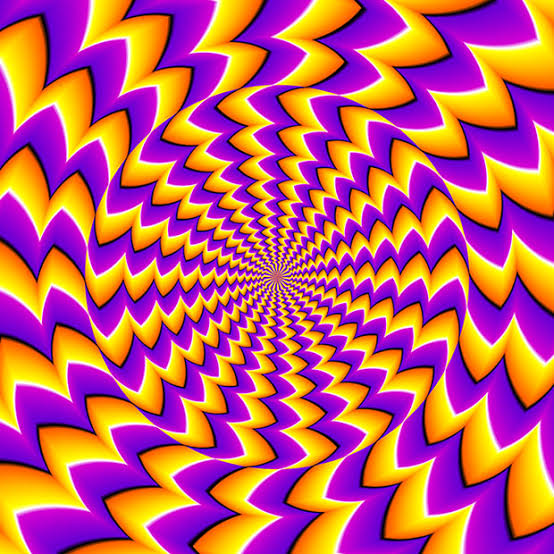
Look at the classic checker-shadow illusion: two squares on a checkerboard appear to be different shades of gray, one dark and one light. Yet if you place a physical strip of paper over both squares, you’ll find they are, pixel for pixel, the exact same color. Your eyes aren’t broken. Your brain is doing something far more interesting than simply recording light — it’s interpreting it.
Optical illusions have fascinated scientists, artists, and philosophers for centuries, not because they’re clever tricks, but because they expose the machinery of perception itself. Every illusion is a experiment the brain unknowingly participates in, revealing the shortcuts, assumptions, and predictive models it uses to construct the world we “see.” This blog explores why illusions happen, what they reveal about the biology of vision, and why understanding them matters far beyond party tricks and Instagram-famous images.
The Eye Is a Camera, But the Brain Is Not a Screen
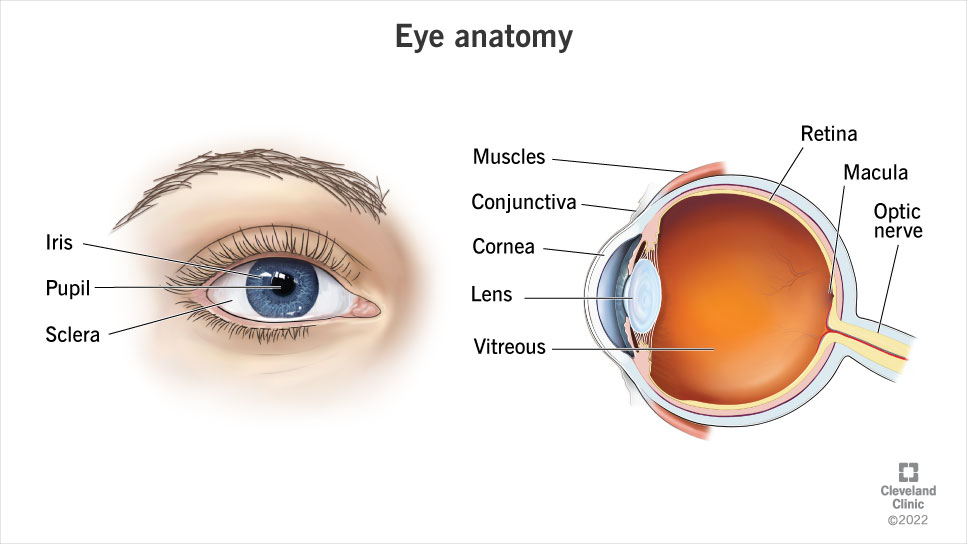
A common misconception is that vision works like a camera: light enters the eye, hits the retina, and produces a picture that gets projected onto some internal “screen” in the brain. In reality, nothing like a screen exists. The retina converts light into electrical signals, which travel via the optic nerve to the visual cortex at the back of the brain. From there, information is distributed across dozens of specialized regions — some process motion, others color, others faces, others depth.
Crucially, the brain doesn’t passively receive this information. It actively predicts what it expects to see based on past experience, context, and statistical regularities of the natural world, then compares that prediction against incoming sensory data. This is sometimes called “predictive processing” or the brain-as-a-prediction-machine model. Illusions occur precisely when this predictive system encounters an image engineered to violate its normal assumptions.
Why Illusions Exist: The Brain’s Necessary Shortcuts
The visual world delivers an overwhelming amount of raw data every second. If the brain tried to process every photon and pixel with total literal accuracy, it would be paralyzed by computational overload. Instead, evolution favored a brain that uses heuristics — fast, efficient rules of thumb that are usually right, even if occasionally wrong.
Some of the most important heuristics include:
Assuming light comes from above. Because sunlight has always come from the sky, our visual system automatically assumes an overhead light source when judging shape and depth from shading. This is why the “crater illusion” makes indentations look like bumps when a photo is flipped upside down.
Filling in missing information. Your retina has a literal blind spot where the optic nerve exits the eye, yet you never perceive a hole in your vision. The brain seamlessly fills the gap using surrounding visual context.
Prioritizing edges and contrast over absolute values. As the checker-shadow illusion shows, the brain cares less about the exact brightness of a surface and more about how it relates to its surroundings. This is called “lateral inhibition” — neurons that detect edges suppress the response of neighboring neurons, exaggerating contrast at boundaries.
Assuming objects are stable and continuous. This is why illusions like the Kanizsa Triangle — where we perceive a bright triangle that isn’t actually drawn — occur. The brain infers continuous shapes from fragmented cues because, in nature, partially occluded objects are still whole objects.
The Neuroscience Behind Specific Illusions
The Müller-Lyer Illusion
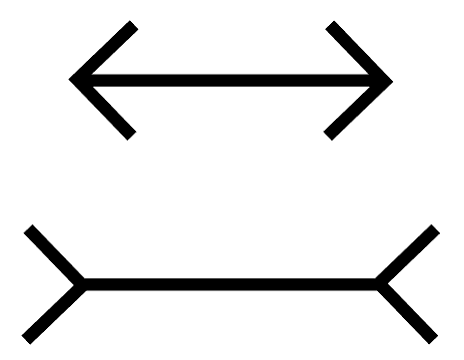
Two lines of identical length appear different because one has arrow-like fins pointing inward and the other outward. Researchers believe this illusion taps into the brain’s use of depth cues learned from a “carpentered” environment — one full of corners, buildings, and rectilinear architecture. Interestingly, cross-cultural studies (notably by Marshall Segall and colleagues in the 1960s) found that people from societies with fewer straight-edged structures, such as certain rural African communities, were less susceptible to this illusion. This suggests visual perception isn’t purely hardwired — it’s shaped by the environments we grow up in.
The Ames Room
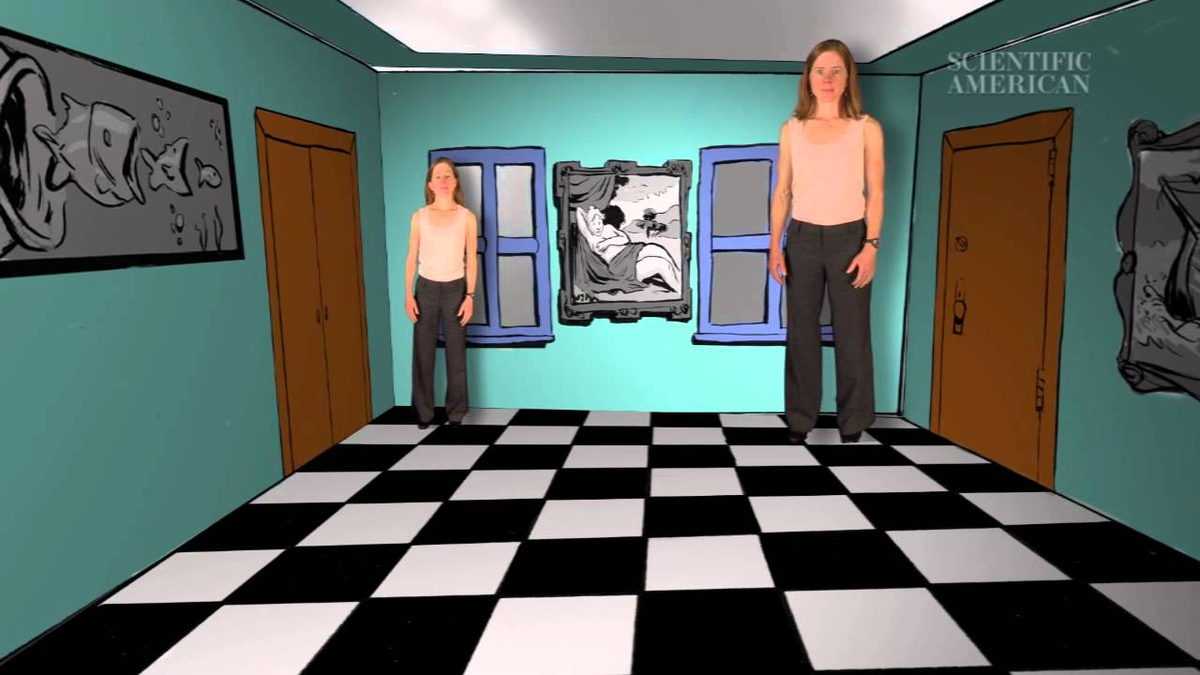
A room built with a distorted, trapezoidal shape can make a person standing in one corner look like a giant, and a person in the other corner look tiny, even though both are the same height. The brain assumes the room is a normal rectangular shape because most rooms we encounter are rectangular. This illusion demonstrates how deeply the brain relies on prior assumptions about geometry.
Motion Aftereffects (The Waterfall Illusion)
Stare at a waterfall for a while, then look at a stationary rock nearby — it will appear to drift upward. This happens because motion-detecting neurons in the visual cortex adapt to constant downward motion, becoming fatigued. When you shift your gaze, the imbalance between “downward” and “upward” motion detectors creates a false signal of movement in the opposite direction.
The Dress and the Dynamic of Color Constancy
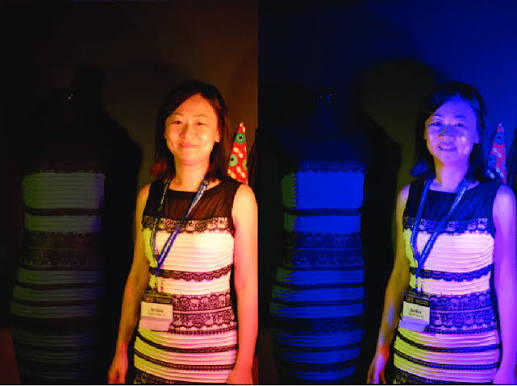
In 2015, a photo of a dress divided the internet — some saw it as blue and black, others as white and gold. This wasn’t a hoax; it was a genuine demonstration of color constancy, the brain’s method of correcting perceived color based on assumed lighting conditions. If your brain assumed the dress was lit by warm indoor light, it “subtracted” yellow tones, making you see blue and black. If it assumed cool, bluish daylight, it subtracted blue, revealing white and gold.
What Illusions Reveal About Brain Biology
1. Vision Is Constructive, Not Photographic
Perhaps the most important lesson from optical illusions is that seeing is an active, generative process. The brain builds a model of reality using incomplete, ambiguous, and noisy data, then fills in gaps using probability and prior knowledge. This aligns with the Bayesian brain hypothesis, which proposes that the brain constantly makes probabilistic inferences about the world, updating its beliefs as new evidence arrives.
2. Different Brain Regions Specialize and Sometimes Disagree
Illusions often arise from a kind of internal disagreement between visual subsystems. For instance, the “ventral stream” (responsible for recognizing what an object is) and the “dorsal stream” (responsible for guiding motor action, like reaching for an object) can be fooled differently. Some studies show that even when a person’s conscious perception is deceived by an illusion, their hand movements when reaching for the object remain accurate — suggesting the action-guidance system uses different, more literal information than the perception system.
3. Perception Is Shaped by Experience and Culture
As the Müller-Lyer cross-cultural studies suggest, the “hardware” of the eye may be universal, but the “software” of perception is calibrated by lived experience. This has powerful implications: our brains are not passive recorders of an objective reality but active interpreters shaped by the environments, cultures, and expectations we grow up with.
4. The Brain Prioritizes Efficiency Over Accuracy
Illusions are, in a sense, the cost of doing business efficiently. A visual system that took the time to calculate every scene with perfect literal accuracy would be too slow to keep an organism alive in a world full of predators, moving vehicles, and fast decisions. Illusions are the visible seams where speed was chosen over precision — and in evolutionary terms, that trade-off has served us extraordinarily well.
Real-World Applications
Understanding optical illusions isn’t just academic. It has practical uses across multiple fields:
- Clinical neuroscience: Illusions help diagnose and study neurological conditions. Patients with certain brain lesions, for instance, may lose susceptibility to specific illusions, helping researchers map which brain regions are responsible for particular perceptual functions.
- User interface and product design: Designers exploit principles of perceptual grouping and contrast (informed by illusion research) to make interfaces intuitive or, conversely, to avoid unintended visual confusion.
- Aviation and road safety: Understanding illusions like the “moon illusion” (why the moon looks larger near the horizon) or motion misjudgments has informed pilot training and road design, since visual misjudgment of speed and distance can be dangerous.
- Art and architecture: From Renaissance trompe-l’œil paintings to modern optical art by artists like Bridget Riley, illusions have long been deliberately engineered to create emotional or spatial effects.
Conclusion: A Window Into the Mind’s Machinery
Optical illusions are far more than visual party tricks. They are windows into the extraordinary, imperfect, and endlessly adaptive machinery of the human brain. Each illusion is essentially a controlled experiment, stripping away the confidence we place in what we “see” and revealing the elaborate inferential process happening beneath conscious awareness.
In a strange way, being deceived by an illusion is proof of just how sophisticated our brains are — capable of taking fragmented, ambiguous, and often contradictory sensory information and constructing a coherent, useful model of reality in milliseconds. The next time your eyes “deceive” you, remember: it’s not really deception. It’s your brain doing exactly what it evolved to do — making its best guess about a world it can never fully know with certainty.