रावण के दस सिर, दशहरे से हर विद्यार्थी क्या सीख सकता है
October 21, 2026
दीया जलाने से पहले अँधेरा तो पहचानो
November 5, 2026
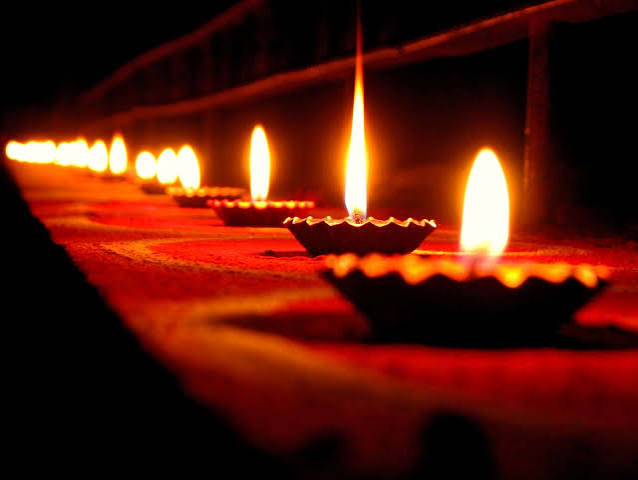
Every year, around this time, a billion people clean their homes, buy new clothes, and light lamps. Hardly anyone stops to ask: why?
Not “what is the story?” Everyone knows the story. The question is deeper: what is this festival asking of me?
If Diwali has become a ritual you perform on autopilot, it has already stopped being a festival. A festival that does not change you is only a holiday.
What We Think We Know
The popular story is simple. After fourteen years of exile, Ram returns to Ayodhya, having defeated Ravana. The people light lamps to welcome him home. Hence, Deepavali: deepa (lamp) and avali (row).
But look at how many stories live inside this one night.
For Jains, Diwali marks the nirvana of Mahavira, traditionally dated to 527 BCE. His disciples, the story goes, said that the light of knowledge had left the world, so they lit lamps to replace it. For Sikhs, the same season is Bandi Chhor Divas, remembering 1619, when Guru Hargobind was released from Gwalior Fort and insisted that the 52 princes imprisoned with him be freed too. In Bengal, the night belongs to Kali, not Lakshmi. In much of western and southern India, it’s about Krishna and Narakasura.
Different regions, different religions, different heroes. Yet one thing is common to all of them: a victory of light over darkness.
When so many traditions, with so many different stories, converge on the same symbol, the symbol is the truth and the story is just its vehicle. Mistaking the vehicle for the destination is the oldest mistake in religion.
Why Amavasya?
Here is something worth noticing. Diwali falls on Amavasya, the new moon night, the darkest night of the lunar month.
Why would we choose the darkest night to celebrate? Why not the full moon, when the sky is already bright?
Because a lamp has no meaning in light. It matters only in darkness. A lamp lit at noon is decoration. A lamp lit at midnight is salvation.
So the festival begins with an uncomfortable honesty: there is darkness. Before any celebration, you must admit the darkness. Most of us never do. We decorate the walls, hang the lights, and leave the inner room untouched. We buy new things to avoid looking at the old confusion.
Ram, Ravana, and the War Within
Let’s ask the question few people ask: who is Ravana?
He is not a stupid villain. He is learned, a master of the Vedas, a devoted worshipper of Shiva, a brilliant king. Everything a person could be proud of, Ravana had.
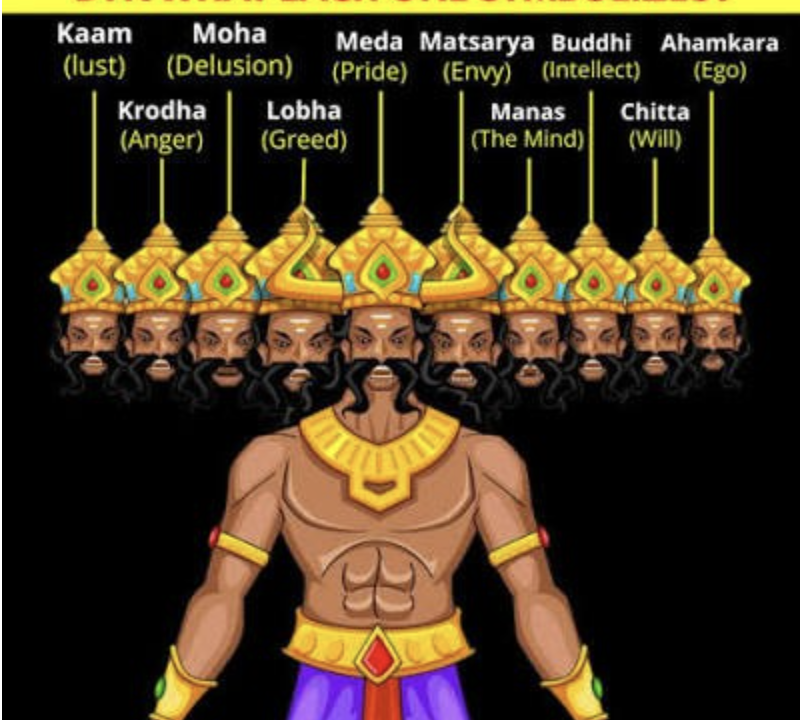
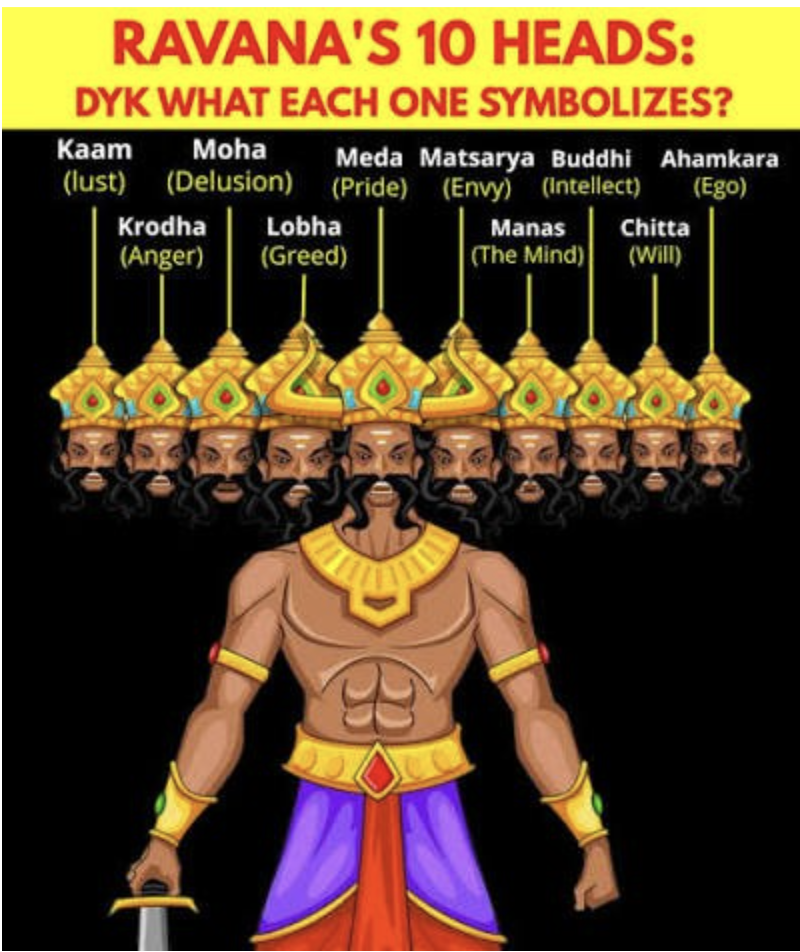
The ten heads are usually read as ten vices. But look closer: the heads of Ravana are ten minds. A man with ten heads has ten opinions, ten desires, ten voices pulling him in ten directions. That is the condition of the ordinary human being. Ask yourself: how many voices spoke inside you in the last one hour? Career, fear, approval, comparison, lust, resentment, nostalgia, ambition, the phone, what people will say. That is Ravana’s court, and it sits in your head.
Ram, on the other hand, is the one who has one direction. Ram is not just a king or an avatar. In the tradition of Kabir and the Upanishads, Ram is the name for the Truth, the Real, the Self. Kabir sang of a Ram who is not the son of Dasharatha, a Ram without form.
Read that way, the Ramayana is not history. It is a map:
- Sita is your peace and your wholeness, abducted by the ego.
- Ravana is the ego, with its borrowed power and its ten voices.
- Ram’s return to Ayodhya is the mind coming home to itself.
And Ayodhya literally means “that which cannot be fought against”. It is a state beyond conflict. The fourteen years of exile are the years of living away from yourself. Diwali is the return.
So the real question is not “Did Ram return?” The real question is: have you?
The Owl and the Goddess
On Diwali night, the household worships Lakshmi, goddess of wealth. And her vehicle, the vahana, is the owl.
Why the owl? An owl sees in darkness and is blind in daylight. Wealth, when it comes without wisdom, becomes exactly that. A person who is rich but unillumined can navigate the dark corridors of greed with great skill, yet he is blind to the light of what actually matters.
The tradition pairs Lakshmi with Ganesh, the remover of obstacles and the lord of intelligence. The point is hard to miss. Wealth without wisdom is a curse dressed as a blessing.
Look at our own practice. Dhanteras has become the day when gold is bought. Trade bodies estimate that festive-season retail business in India runs into several lakh crores of rupees every year. There is nothing wrong with prosperity. But ask honestly: is the money we spend on Diwali coming from a place of joy, or from a place of comparison? Are we buying because we need something, or because the neighbour did?
When consumption is driven by comparison, you are not celebrating. You are competing.
The Price of Our Celebration
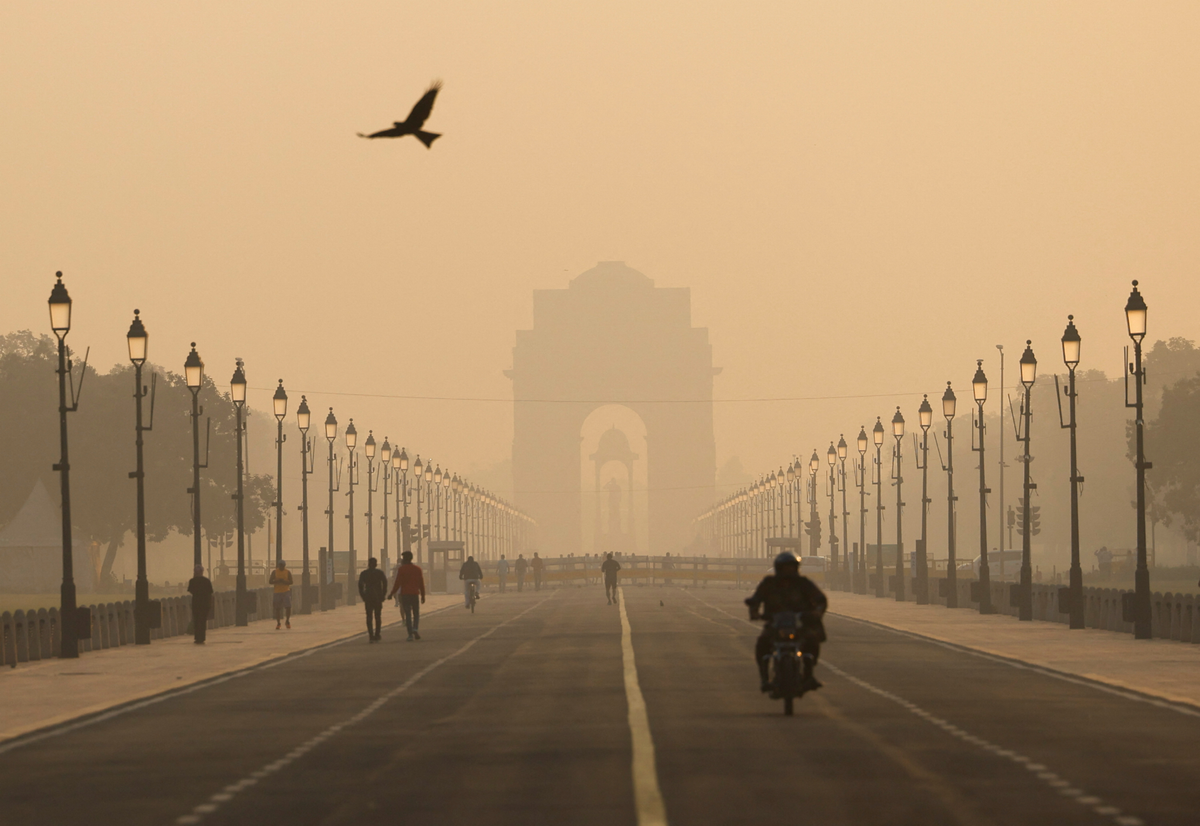
Now let us look at facts we would rather ignore.
Every year, in the days after Diwali, the air quality in Delhi and much of north India worsens drastically. PM2.5 readings often climb to several times the national safe limit, and many times the WHO guideline, as firecracker smoke mixes with stubble burning and winter inversion. Hospitals report more patients with breathing trouble. Birds and street animals suffer. Sivakasi, which produces the bulk of India’s fireworks, has also seen repeated factory accidents, and the workers who make our “joy” are often poor, underpaid, and at risk.
Here is a simple question: what exactly are we celebrating, if the celebration chokes the very people we claim to love?
A child with asthma is not served by your sparkler. An elderly parent struggling for breath is not honoured by your noise. If your joy requires someone else’s suffering, it isn’t joy. It is a habit we have named “tradition”.
Tradition is a river, not a pond. A river keeps moving and keeps cleansing itself. A pond that refuses to change turns stagnant. The Ayodhya of the Ramayana did not light lamps with firecrackers; it lit ghee and oil lamps. Light, not noise, was always the point.
(Incidentally, in recent years Ayodhya’s Deepotsav has set records of over 25 lakh lamps lit at once. The scale is spectacular. But the lamp that matters is the one that doesn’t need to be counted.)
“Appo Deepo Bhava”
Close to his death, the Buddha told his disciple Ananda: Appa dipo bhava, “Be a lamp unto yourself.”
Consider the courage in that sentence. The teacher says: do not depend on me, do not depend on my words, do not depend on tradition. Find your own light.
This is the most radical message of any festival of lights. Everyone is looking for someone else’s lamp: a guru, a scripture, a leader, a trend, a “like”. The Buddha says all those lamps are borrowed, and a borrowed lamp goes out when the lender leaves.
The ancient prayer in the Brihadaranyaka Upanishad says: Tamaso ma jyotirgamaya, “lead me from darkness to light.” But notice: it is a prayer by someone who has already understood that he is in darkness. That recognition is the first lamp.
What Should You Actually Do This Diwali?
Not a checklist, but a few honest questions to take with you:
1. What is your Ravana? Name one voice in your head that has been ruling your decisions: fear of failure, the need for approval, an old resentment. Don’t try to destroy it in a day. Just see it. Seeing is the beginning of burning.
2. Whose lamp are you holding? Which of your beliefs, goals, or opinions did you actually examine, and which did you inherit? A life built entirely on inherited beliefs is a house lit by someone else’s lamp.
3. What does your celebration cost others? Before you spend, burn, or buy, ask: is this making me lighter, or only louder?
4. What is your Ayodhya? Where is the place in your life, a work, a relationship, a silence, where you feel at home with yourself? Go back there, even for ten minutes today.
5. Whom can you light a lamp for? A lamp loses nothing by lighting another lamp. Sit with someone who is struggling. Teach something. Forgive someone. That is the only kind of generosity that never runs out.
The Last Lamp
The oil in a diya is limited. By morning, it is gone. The lamp we light outside lasts a night.
But there is a lamp that does not need oil, does not flicker in the wind, and does not go out when the festival ends. The saints called it by many names: Atman, Ram, Self, Truth. You do not light it. You only remove what hides it.
So go ahead and light the diyas this Diwali. Clean the house, eat the sweets, meet the family. But when you place that small lamp at your door, let it be a reminder and not a substitute:
The outer lamp is a symbol. The inner lamp is the answer.
Shubh Deepavali. Not just to your home, but to the mind that lives in it.