

सूर्यास्त के समय आसमान लाल क्यों हो जाता है? (जबकि दिनभर यह नीला रहता है)
September 25, 2026
बिजली चमकने के बाद गरज की आवाज़ देर से क्यों सुनाई देती है?
September 30, 2026
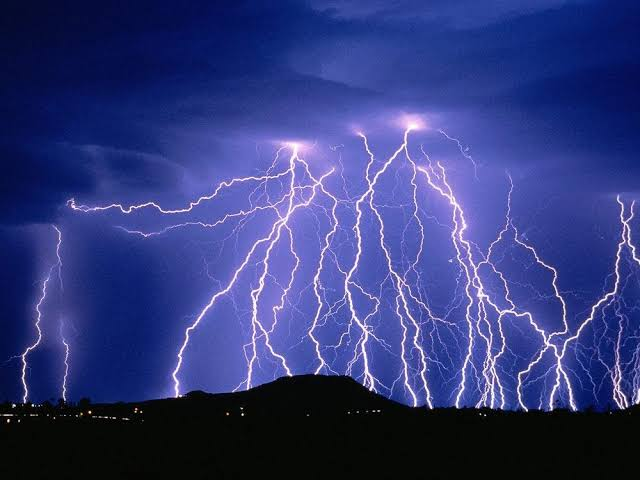
You’ve noticed this during almost every monsoon storm: a flash of lightning streaks across the sky, and only after a gap of a few seconds does the rumble of thunder reach you. Sometimes the gap is barely noticeable. Sometimes you can count five, six, even ten seconds before the sound arrives.
Here’s the interesting part: the lightning and the thunder actually happen at the exact same moment, in the exact same place. So why does one reach you almost instantly while the other takes its time?
Lightning and Thunder Are Born Together
During a thunderstorm, electrical charge builds up inside clouds — and between clouds and the ground — until it’s powerful enough to force a sudden, massive discharge of electricity. This discharge is lightning: a channel of air heated so intensely, so fast (to roughly 30,000°C, hotter than the surface of the sun), that the air around it explosively expands.
That explosive expansion of superheated air is what creates the shockwave we hear as thunder. In other words, thunder isn’t a separate event that follows lightning — it’s the sound of the lightning strike itself. They happen simultaneously, at the same location, at the same instant.
So if they happen together, why don’t we experience them together?
The Real Reason: Light and Sound Don’t Travel at the Same Speed
This whole phenomenon comes down to one simple fact: light travels far faster than sound.
- Light travels at about 300,000 kilometers per second.
- Sound travels at about 343 meters per second (roughly 1,235 km/h) through air.
To put that gap in perspective: light could travel around the entire Earth about seven times in one second. Sound, in that same second, would barely cross three football fields.
So when lightning strikes a few kilometers away, the light from it reaches your eyes almost instantly — for all practical purposes, the moment it happens. But the sound of that same strike has to physically push through the air, molecule by molecule, all the way to your ears. That takes real, measurable time.
The farther away the storm, the longer that sound has to travel — which is exactly why the gap between the flash and the rumble grows or shrinks depending on how close the storm is to you.
A Simple Way to Picture It
Imagine two runners starting a race from the exact same spot at the exact same time — one is a rocket, the other is walking. The rocket (light) reaches the finish line (your eyes) almost instantly, no matter how far away the finish line is. The walker (sound) is still making their way there, step by step, and takes a noticeably longer time to arrive if the distance is large.
Both started together. Only one arrives immediately.
You Can Actually Calculate the Distance to a Storm
Because the speed of sound in air is well known and fairly constant, you can use this time gap to estimate how far away a lightning strike actually happened — a trick used by meteorologists, pilots, and outdoor enthusiasts alike.
The method is simple:
- The moment you see the lightning flash, start counting seconds.
- Stop counting the moment you hear the thunder.
- Divide the number of seconds by 3 — this gives you the approximate distance in kilometers.
So if you count 9 seconds between the flash and the rumble, the lightning struck roughly 3 km away. If you count 15 seconds, it’s about 5 km away.
(Why divide by 3? Sound travels roughly 1 km every 3 seconds in air — a rounded, easy-to-use approximation of that 343 m/s speed.)
This isn’t just a fun trick — it’s a genuinely useful safety measure. A shorter gap means the storm is closer, and a good general safety rule is: if the gap is 30 seconds or less (storm within roughly 10 km), it’s time to head indoors, since lightning can strike well ahead of where the rain itself is falling.
Why You Sometimes Don’t Hear Thunder at All
If you’ve ever seen lightning flash silently in the distance with no thunder at all, that’s not a different kind of lightning — it’s ordinary lightning that’s simply too far away. Thunder’s sound weakens and scatters as it travels, and beyond roughly 20–25 km, it usually fades below what the human ear can detect, even though the flash of light remains visible from much farther away. This distant, soundless flickering is sometimes called “heat lightning,” though it’s really just regular lightning from a storm too far off to be heard.
Why This Isn’t Just “Trivia”
This everyday storm-watching observation is a direct, real-world demonstration of a core physics idea: different forms of energy — light waves and sound waves — travel through the same medium (air) at very different speeds. The same underlying principle explains:
- Why you see a hammer strike a nail slightly before you hear the clang, when watching from far away
- Why fireworks look like they burst before you hear the boom
- How echo-location and sonar work, by measuring the time a sound wave takes to travel and bounce back
The next time a Physics chapter covers the speed of sound, or the difference between how light and sound propagate, you won’t just be reading a formula — you’ll already have counted the seconds yourself, standing outside during a storm.
Try It Yourself
During the next monsoon storm (from a safe distance indoors, near a window), try the counting method for a few different lightning flashes. Notice how storms moving toward you produce a shrinking gap over time, while storms moving away produce a widening one. You’re not just watching weather — you’re timing two different speeds of energy racing to reach you.