
पढ़ाई के दौरान एकाग्रता कैसे बढ़ाएं
July 6, 2026
Why Is Participating in Online Competitions So Important?
July 15, 2026

Look up on any clear afternoon and you’ll see it: that deep, endless blue stretching from horizon to horizon. It’s such a familiar sight that most of us never stop to ask why. But it’s a genuinely interesting question, and the answer touches on light, physics, and even a bit of history.
Let’s break it down in plain language, no physics degree required.
Sunlight Isn’t Actually White
The first thing to understand is that sunlight, which looks white or pale yellow to our eyes, is actually a mix of every color in the rainbow. You’ve probably seen this proven with a prism, or naturally through a rainbow after rain. White light is really red, orange, yellow, green, blue, indigo, and violet light all traveling together.
Each of these colors is a wave of light, and each wave has a different length. Red light has long, lazy waves. Blue and violet light have short, tightly packed waves. This difference in wavelength turns out to be the whole key to the mystery.
The Atmosphere Is Full of Tiny Obstacles
Earth’s atmosphere isn’t empty space. It’s packed with countless tiny gas molecules, mostly nitrogen and oxygen, along with specks of dust and water vapor. These particles are far smaller than the wavelength of visible light.
When sunlight enters the atmosphere and crashes into these molecules, something interesting happens. Instead of passing straight through, the light gets scattered, meaning it bounces off in random directions.
But here’s the twist: not all colors scatter equally.
Enter Rayleigh Scattering
Because blue and violet light have shorter, choppier waves, they interact with these tiny air molecules far more easily than the longer waves of red and orange light. In fact, blue light scatters about four times more than red light does.
This phenomenon has a name: Rayleigh scattering, named after the 19th-century British physicist Lord Rayleigh, who worked out the mathematics behind it. The simplified version of his finding is that shorter wavelengths scatter more strongly than longer ones when they hit particles smaller than the wavelength itself.
So as sunlight pours into our atmosphere, the blue light gets grabbed and flung around in every direction, again and again, by molecule after molecule. Red and orange light, meanwhile, mostly cruise straight through undisturbed.
The result is that no matter where you look in the sky, away from the sun itself, you’re seeing scattered blue light arriving at your eyes from every angle. That’s the blue sky.
Wait, Shouldn’t the Sky Be Violet?
This is a great question, and it trips up a lot of people. Violet light actually scatters even more than blue light, since its wavelength is even shorter. So by the numbers, the sky should technically look violet, not blue.
Two things save us from a violet sky:
First, sunlight simply contains less violet light to begin with compared to blue.
Second, and more importantly, human eyes aren’t equally sensitive to all colors. Our eyes have three types of color receptors (cones), tuned to red, green, and blue. We’re much better at detecting blue than violet, and when our eyes pick up a mix of scattered blue and violet light, our brain interprets it as blue rather than violet.
So it’s a combination of the physics of scattering and the biology of human vision that gives us a blue sky rather than a purple one.
Why Sunsets Turn Red and Orange
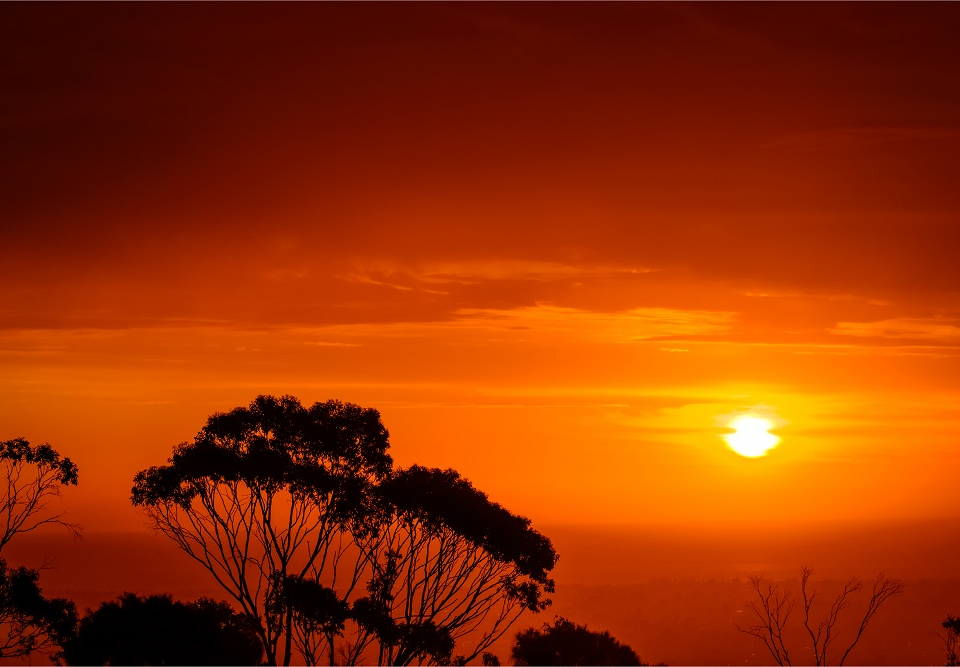
This same scattering effect explains one of nature’s other great shows: the fiery colors of sunrise and sunset.
When the sun is low on the horizon, its light has to travel through a much thicker slice of atmosphere to reach your eyes, compared to when the sun is directly overhead. Over that longer path, almost all the blue and violet light gets scattered away long before it reaches you, scattered off in other directions, away from your line of sight.
What’s left to reach your eyes directly are the longer wavelengths, the reds, oranges, and pinks, painting the sky in warm colors. That’s why sunsets look so different from the blue of midday sky; it’s the exact same phenomenon, just viewed through a much longer stretch of atmosphere.
Why Isn’t Space Black in the Daytime Sky But Black at Night?
If scattering is what colors the sky, you might wonder why the sky doesn’t glow blue at night too. The answer is straightforward: at night, your side of the Earth faces away from the sun, so there’s no direct sunlight entering the atmosphere above you to scatter in the first place. Without sunlight to scatter, there’s no blue glow, and space’s natural blackness shows through, along with the stars.
Why Isn’t the Sky Blue on Mars?
As a fun contrast, consider Mars. Its atmosphere is extremely thin and made mostly of carbon dioxide, with very little of the kind of fine molecular content that drives strong Rayleigh scattering. Instead, Mars’s air is full of fine dust particles that scatter light differently than gas molecules do. This is part of why the Martian sky often looks butterscotch or pinkish rather than blue, and interestingly, sunsets on Mars can appear bluish, essentially the opposite pattern from Earth.
The Simple Version
If you want the one-sentence explanation to remember: Sunlight contains all colors, but as it passes through our atmosphere, the tiny gas molecules scatter short-wavelength blue light far more than the longer wavelengths of red and orange, and that scattered blue light reaching our eyes from all directions is what colors the sky.
It’s a wonderfully elegant answer, once you know it. A phenomenon so ordinary that we barely notice it turns out to be a beautiful demonstration of wave physics playing out right above our heads, every single day.
Next time you catch a sunset turning the sky orange and pink, or simply glance up at a clear blue afternoon, you’ll know exactly what’s happening: countless invisible collisions between sunlight and air, quietly painting the sky.